Aurorae
Aurora forecasts and the effects of auroral activity on radio propagation.

Introduction
Aurorae (the Aurora Borealis in the Northern Hemisphere and the Aurora Australis in the Southern Hemisphere) are produced when energetic charged particles precipitate from the magnetosphere into Earth's upper atmosphere at high geomagnetic latitudes. Auroral activity is typically enhanced when the Interplanetary Magnetic Field (IMF) is strong and its Bz component is directed southward upon reaching Earth. Under these conditions, magnetic reconnection between the IMF and Earth's magnetic field becomes more efficient, allowing increased transfer of solar-wind energy and momentum into the magnetosphere.
The precipitating energetic particles are guided by Earth's magnetic field into the auroral regions, where they collide with atoms and molecules in the upper atmosphere. These collisions transfer energy to atmospheric constituents, particularly atomic oxygen and molecular nitrogen, which subsequently emit light as they return to lower-energy states. The characteristic colours of the aurora depend on the emitting species, atmospheric density, altitude, and the energy of the precipitating particles. Green, the most common auroral colour, is primarily produced by atomic oxygen at altitudes of roughly 100–150 km, while red emissions from atomic oxygen occur mainly at higher altitudes, typically above about 200 km. Blue and violet emissions are principally associated with molecular nitrogen and ionized molecular nitrogen, generally at lower altitudes where energetic particle precipitation penetrates deeper into the atmosphere. Mixtures of these emissions can also produce pink, purple, and other intermediate colours, particularly along the lower edges of intense auroral displays.
Auroral activity produces significant disturbances in the high-latitude ionosphere, including enhanced ionization, strong ionospheric currents, and irregularities in electron density. These conditions can affect radio propagation in different ways depending on frequency and propagation mode. HF signals crossing the auroral zone may experience increased absorption, scattering, rapid fading, and phase variations, potentially degrading or disrupting communications over high-latitude paths. At VHF frequencies, however, intense auroral ionization can act as an effective scattering region, allowing signals to propagate well beyond the normal line-of-sight range through auroral propagation. Signals received by this mechanism are typically characterized by strong distortion and a distinctive rough or raspy sound due to Doppler spreading produced by the rapidly moving and irregular auroral ionization.
For practical information on when, where, and under what conditions aurorae may be visible, please consult NOAA's tips for viewing the aurora.
Alerts and Forecasts (NOAA)
The auroral oval is a ring-shaped region around a the magnetic poles where auroras are most likely to occur.
During periods of enhanced geomagnetic activity, increased energy input into the magnetosphere can intensify auroral activity and cause the auroral oval to expand toward lower geomagnetic latitudes. Magnetospheric substorms, which are relatively short-lived disturbances involving the sudden release of energy stored in Earth's magnetotail, can produce rapid intensifications and expansions of the aurora. During geomagnetic storms, the auroral oval may expand considerably farther toward the equator than under quiet conditions. Consequently, strong geomagnetic storms can make aurorae visible from regions where they are rarely observed, and during exceptionally intense events they may be seen at unusually low latitudes.
The following maps, provided by NOAA and the University of Alaska Fairbanks, show forecasts of auroral activity in the Northern and Southern Hemispheres. They provide an estimate of the location and intensity of the auroral oval and the geographical regions from which auroral displays may potentially be visible, based on current and predicted space-weather conditions.
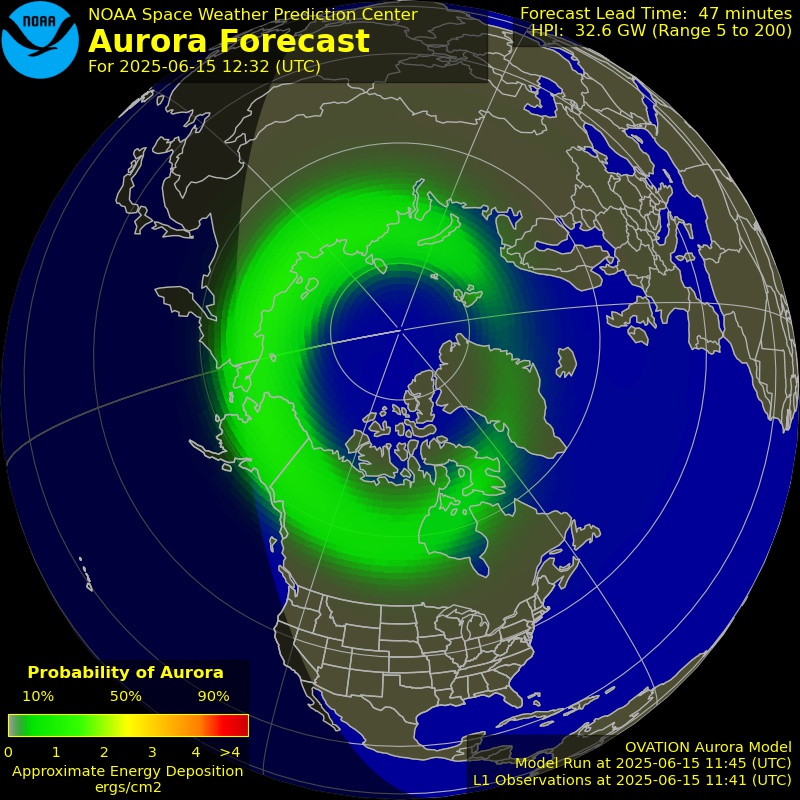
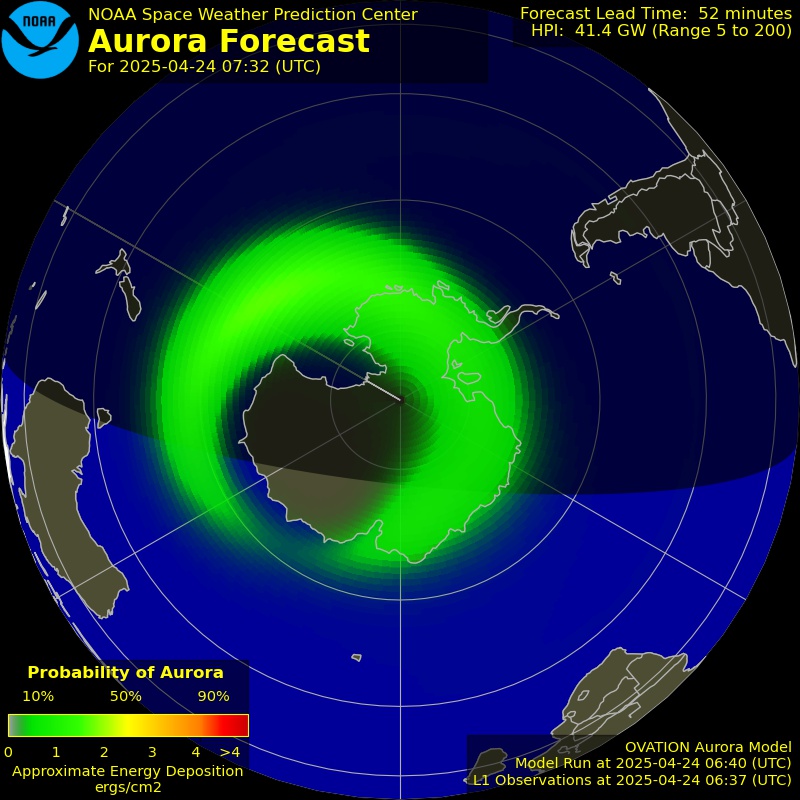
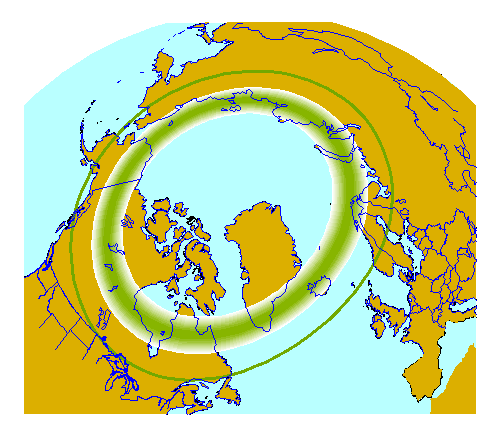
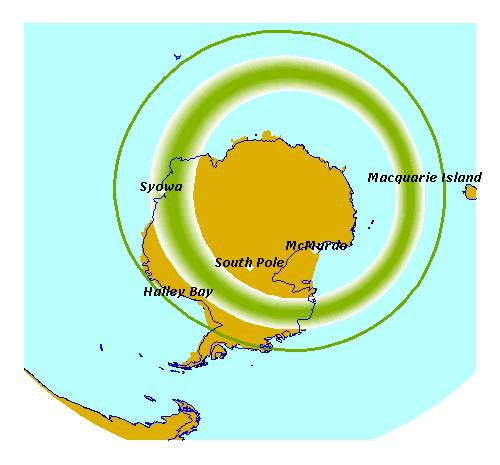

The maps show the predicted location and intensity of auroral activity around the polar regions. They may also include a viewing boundary extending toward lower latitudes, indicating approximately how far from the auroral oval a sufficiently intense auroral display could potentially be seen above the poleward horizon. Consequently, an observer does not necessarily need to be located directly beneath the predicted auroral oval to see the aurora.
Actual auroral visibility depends on several factors in addition to the predicted auroral activity, including local darkness, cloud cover and other weather conditions, light pollution, terrain or horizon obstructions, and the intensity of the auroral display. Observers located equatorward of the auroral oval may need a clear, dark view toward the poleward horizon—northward in the Northern Hemisphere and southward in the Southern Hemisphere—to observe distant auroras.
HF Radio & Space Weather is a resource dedicated to the operational monitoring of space weather and HF propagation conditions.
This is an educational, non-commercial website. All displayed data is property of their authors and credit and hyperlinks to the corresponding sources are provided. If you want to contact the webmaster, please use this form.