Sun-Earth Interaction
Monitoring of the solar wind, interplanetary magnetic field and magnetopause status.

Introduction
The interaction between the Sun and the Earth is primarily governed by the solar wind and its associated magnetic field. The solar wind is a continuous flow of electrically charged particles (plasma) originating in the solar corona and propagating throughout the Solar System. It consists mainly of protons (hydrogen nuclei), electrons, and much smaller proportions of helium nuclei and heavier ions. Associated with the solar wind is a magnetic field known as the Interplanetary Magnetic Field (IMF), which, as a result of the Sun's rotation, adopts a spiral structure known as the Parker spiral.
When the solar wind and the IMF reach Earth, they interact with the planet's magnetic field, known as the geomagnetic field, which acts as a protective shield against much of the solar wind and its associated disturbances.
During periods of enhanced solar activity, particularly when high-speed solar-wind streams or coronal mass ejections (CMEs) reach Earth, the magnetosphere can be compressed and disturbed. When the solar wind and interplanetary magnetic field couple efficiently with Earth's magnetic field, these disturbances may develop into geomagnetic storms. Separately, solar eruptions can accelerate high-energy protons and other ions that may produce solar radiation storms. Such space-weather events can affect satellite operations, radio communications, navigation systems, and, in severe cases, electrical power infrastructure.
Solar wind
The solar wind is a constant outflow of charged particles and embedded magnetic fields that expands outward from the solar corona and carries the Sun's magnetic field into interplanetary space. High-speed streams originating from coronal holes and transient disturbances associated with coronal mass ejections (CMEs) may trigger geomagnetic disturbances when they interact with Earth's magnetosphere.
The following plots show near-real-time solar-wind measurements obtained by the Solar Wind Electron, Proton, and Alpha Monitor (SWEPAM) aboard NASA's Advanced Composition Explorer (ACE) spacecraft. ACE operates near the Sun–Earth L1 Lagrange point, approximately 1.5 million km upstream of Earth, allowing changes in the solar wind to be detected before they reach the terrestrial magnetosphere. SWEPAM measurements include solar-wind proton density, bulk speed, and temperature.
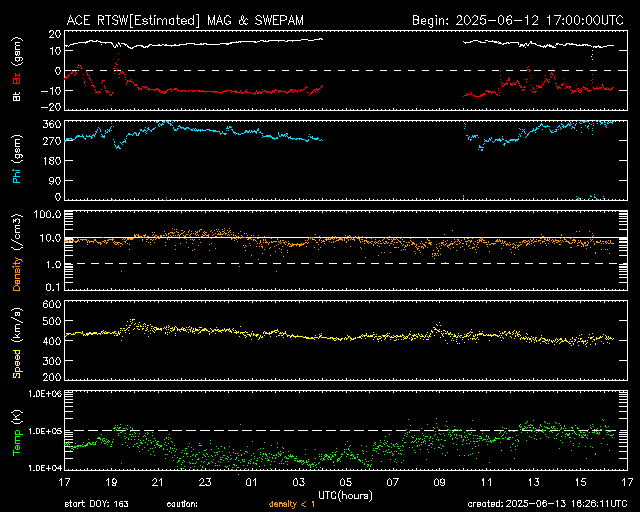

The plots show data from the last 24 hours for the following solar-wind parameters: temperature (K), speed (km/s), proton density (protons/cm³), the angle between the Interplanetary Magnetic Field (IMF) vector and the YZ plane in Geocentric Solar Magnetospheric (GSM) coordinates (φ, degrees), and the Interplanetary Magnetic Field components and magnitude (Bt and Bz, nT).
Solar-wind speed indicates how rapidly the plasma is moving past the spacecraft. Typical solar-wind speeds near Earth are of the order of several hundred km/s, while high-speed streams and CME-related disturbances can produce substantially higher values.
| Solar wind speed (km/s) | Effects |
|---|---|
| >400 | Typical quiet-Sun conditions are often around 300-400 km/s. |
| 400-500 | Often associated with the transition between slow and high-speed streams. |
| 500-700 | Common during high-speed streams from coronal holes or following solar disturbances. |
| 700-1000 | Often associated with strong high-speed streams or fast CME-driven solar wind. |
Proton density indicates the number of solar-wind protons per unit volume. Sudden increases in density, particularly when accompanied by an increase in solar-wind speed, can produce a sharp increase in solar-wind dynamic pressure, compressing the dayside magnetosphere and moving the magnetopause closer to Earth.
Proton temperature provides information about the thermal state of the solar-wind plasma. Changes in temperature, together with changes in speed, density, and magnetic-field properties, can help identify transitions between different solar-wind structures and the passage of interplanetary disturbances.
Interplanetary Magnetic Field (IMF)
The Interplanetary Magnetic Field (IMF) is the magnetic field carried through interplanetary space by the solar wind. Because the Sun rotates approximately once every 27 days, the IMF adopts a spiral structure known as the Parker spiral.
Earth generates its own magnetic field, known as the geomagnetic field, whose field lines extend from one magnetic pole to the other and form a protective region around the planet called the magnetosphere. The outer boundary of the magnetosphere, where the solar wind interacts with Earth's magnetic field, is known as the magnetopause.
Near Earth, both the strength and orientation of the IMF play an important role in determining how efficiently energy is transferred from the solar wind into Earth's magnetosphere.
Of particular importance is the Bz component of the IMF, described in Geocentric Solar Magnetospheric (GSM) coordinates. When Bz is directed southward (negative), the IMF is oppositely directed to the Earth's magnetic field on the dayside magnetopause, favoring magnetic reconnection and allowing more efficient transfer of solar-wind energy into the magnetosphere. If a strong southward Bz persists for a sufficiently long period, auroral activity is enhanced and the probability of geomagnetic storms increases.
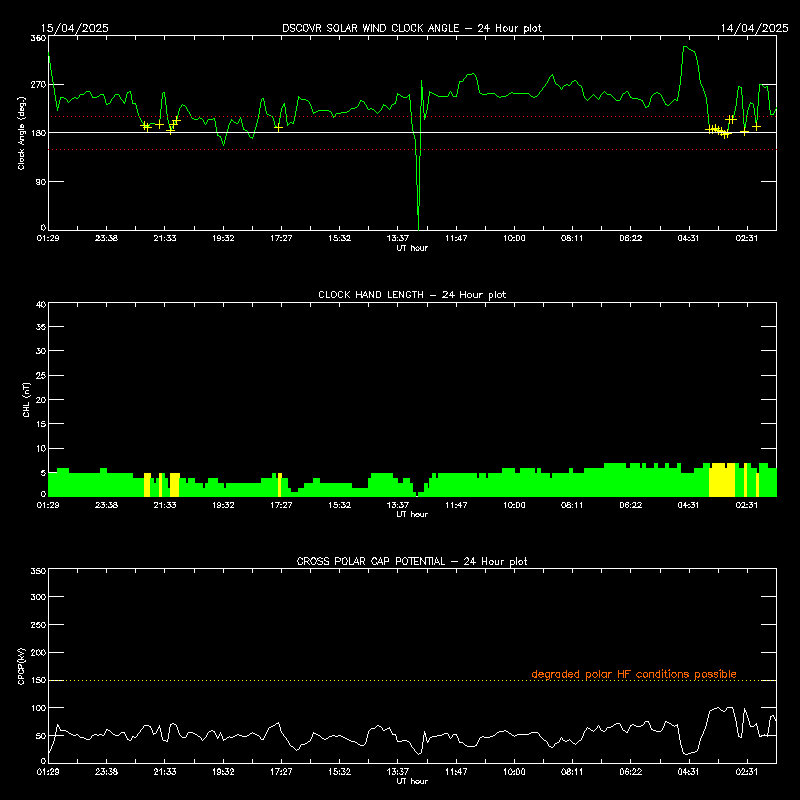
The Interplanetary Magnetic Field (IMF) is a vector field described by three components: Bx, By, and Bz. In the Geocentric Solar Magnetospheric (GSM) coordinate system, the Bz component is particularly important for space-weather monitoring. When Bz becomes negative, the IMF is directed southward relative to Earth's magnetic field. If this southward field is sufficiently strong and persists for a prolonged period, magnetic reconnection can occur more efficiently at the magnetopause, increasing the likelihood of geomagnetic storms.
The plots show the direction of the IMF, expressed as the clock angle, and its magnetic-field strength, represented by the length of the clock hand. In this display, the clock changes to red when the IMF points southward and its magnitude reaches at least 15 nT, highlighting conditions that may favor enhanced coupling between the solar wind and Earth's magnetosphere. If a strong southward IMF persists, magnetic reconnection at the dayside magnetopause can transfer increased amounts of solar-wind energy into the magnetosphere. This energy can drive enhanced magnetospheric and ionospheric currents, increase auroral activity, and, under sufficiently intense and sustained conditions, contribute to the development of a geomagnetic storm.
- 0°: IMF Bz northward (+Bz)
- 90°: IMF By positive (+By)
- 180°: IMF Bz southward (−Bz)
- 270°: IMF By negative (−By)
Magnetopause status
The magnetopause is the boundary that separates Earth's magnetosphere from the surrounding solar-wind plasma. On the Sun-facing side of Earth, its position varies in response to solar-wind conditions and is typically located at a distance of approximately 10 Earth radii (10 RE) from Earth's center. Increases in solar-wind dynamic pressure compress the dayside magnetosphere and move the magnetopause closer to Earth. During sufficiently disturbed conditions, the magnetopause may approach or even move inside geosynchronous orbit, located at approximately 6.6 RE (around 36,000 km in altitude), potentially exposing geosynchronous satellites to the magnetosheath or, in extreme cases, the solar-wind environment.

In both figures, Earth is located at the center and the Sun is to the left (not shown), so the solar wind flows approximately from left to right. The figure on the left shows the magnetosphere in the equatorial (X–Y) plane, viewed from above the North Pole, while the figure on the right shows a meridional (X–Z) cross section, approximately perpendicular to the equatorial plane.
The solar wind flows away from the Sun at supersonic and typically super-Alfvénic speeds relative to Earth, resulting in the formation of a bow shock upstream of the magnetosphere. As the solar wind crosses the bow shock, it slows down, becomes hotter and denser, and is diverted around Earth's magnetosphere through the magnetosheath. On the dayside, the magnetopause forms where the total pressure of the shocked solar-wind plasma and magnetic field is balanced by the pressure within Earth's magnetosphere. Changes in solar-wind dynamic pressure can therefore move the magnetopause inward or outward.
HF Radio & Space Weather is a resource dedicated to the operational monitoring of space weather and HF propagation conditions.
This is an educational, non-commercial website. All displayed data is property of their authors and credit and hyperlinks to the corresponding sources are provided. If you want to contact the webmaster, please use this form.