Geomagnetic Storms
Geomagnetic storm alerts and forecasts, Kp, ap and Ap index monitoring.
Introduction
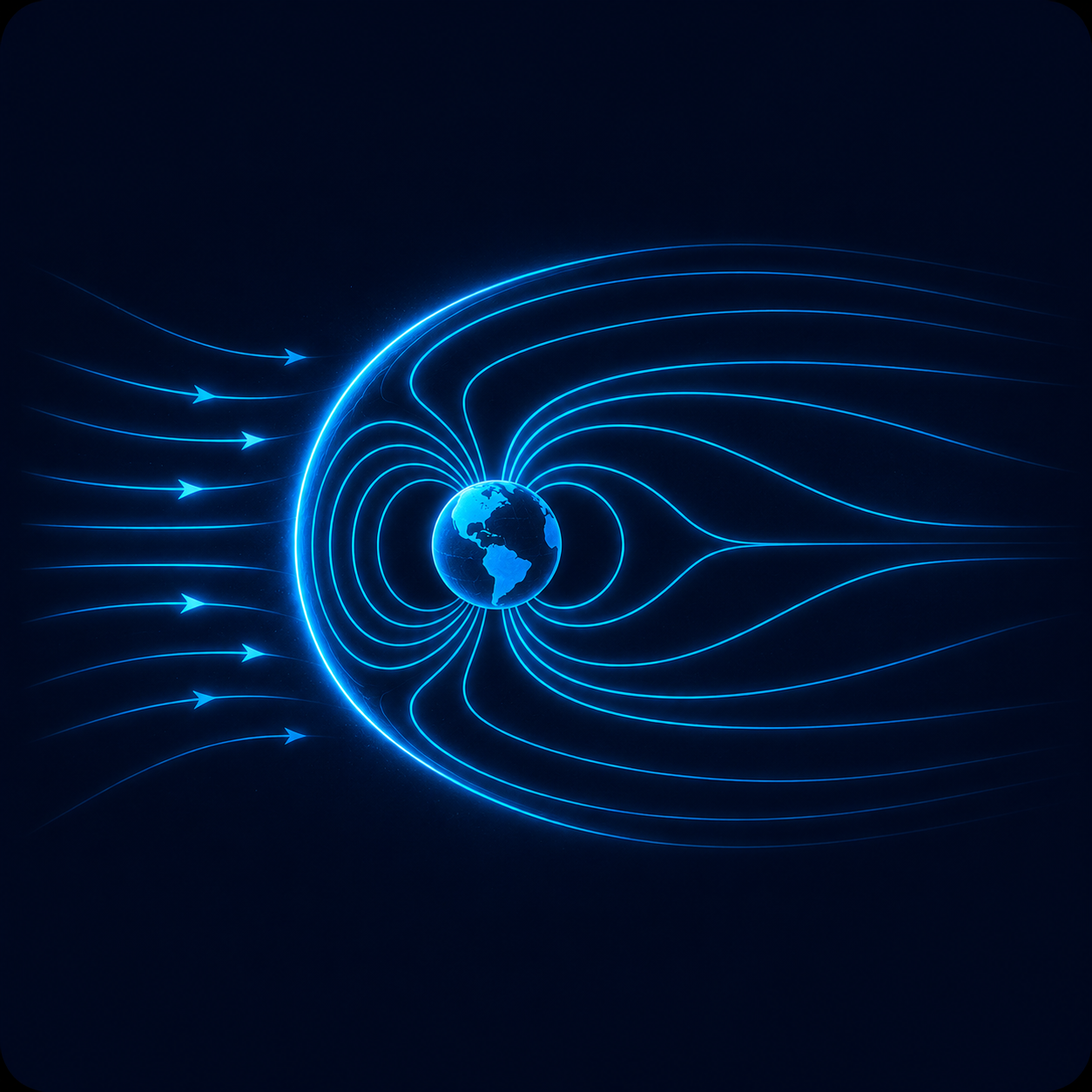
Following a major solar eruption, an Earth-directed coronal mass ejection (CME) may reach Earth in approximately one to several days, although exceptionally fast CMEs can arrive in less than a day. High-speed solar-wind streams originating from coronal holes can also produce disturbed conditions. When these solar-wind structures interact with Earth's magnetosphere, particularly when they carry a strong and sustained southward component of the Interplanetary Magnetic Field (IMF), enhanced transfer of energy into the magnetosphere can trigger a geomagnetic storm, producing disturbances throughout the magnetosphere and ionosphere.
The effects of geomagnetic storms on radio propagation depend on latitude, local time, storm intensity, and frequency. HF communications may be degraded by increased ionospheric absorption, rapid signal fading, and significant changes in ionospheric electron density. These disturbances can create unusual propagation paths while simultaneously disrupting established ones. The most significant effects often occur at high latitudes, where geomagnetic activity is strongest.
Geomagnetic storms can cause both negative and positive variations in the Maximum Usable Frequency (MUF). Negative ionospheric storm effects, associated with reductions in F-region electron density, may significantly lower the MUF and reduce or completely close propagation on the upper HF bands. Positive storm effects can temporarily increase ionospheric electron density and raise the MUF, improving propagation at higher HF frequencies. The magnitude and duration of these effects vary considerably with location, local time, season, and the evolution of the geomagnetic storm.
During geomagnetic storms, please check the HF Absorption Levels and foF2 variations in the Radio Communications section to monitor changes in ionospheric absorption and F-region conditions. Operators using Near Vertical Incidence Skywave (NVIS) communications may also benefit from consulting the latest available ionograms, which provide information about local ionospheric conditions and usable frequencies.
Alerts and Forecasts (NOAA)



The National Oceanic and Atmospheric Administration (NOAA) developed its Space Weather Scales as a means of communicating current and expected space-weather conditions, together with their potential impacts on technological systems and human activities.
The "G scale" describes the intensity of geomagnetic storms and ranges from G1 (Minor) to G5 (Extreme):
| Level | Expected HF impact |
|---|---|
| G1 Minor | Negligible impact in HF communications. |
| G2 Moderate | HF radio propagation can fade at higher latitudes. |
| G3 Strong | HF radio may be intermittent. |
| G4 Severe | HF radio propagation becomes sporadic. |
| G5 Extreme | HF radio propagation may be impossible in many areas for one to two days. |
For a full description of the effects of geomagnetic storms, please check NOAA Space Weather Scales.
Kp Index
The geomagnetic field (Earth's magnetic field) is continuously influenced by its interaction with the solar wind and the Interplanetary Magnetic Field (IMF). Variations in the geomagnetic field are measured by magnetometers at geomagnetic observatories around the world. From these measurements, each observatory can derive a local K index, which characterizes the level of geomagnetic disturbance at that location.
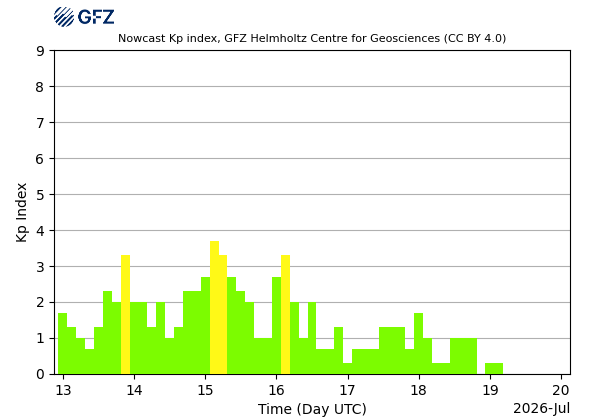
The K index quantifies geomagnetic activity over a three-hour interval on a quasi-logarithmic scale from 0 to 9. The planetary K index (Kp) is derived from standardized K indices measured at a network of 13 subauroral geomagnetic observatories. Kp therefore provides a standardized measure of planetary geomagnetic activity and is widely used to monitor geomagnetic conditions and classify geomagnetic storms.
The following plot, provided by ESA and GFZ Helmholtz Centre for Geosciences, shows the evolution of the planetary Kp index.
The following table shows the relationship between the Kp index, its corresponding linearized ap value, and the NOAA G scale. A brief description of each level is provided.
| Kp | ap | NOAA | Status |
|---|---|---|---|
| Kp = 0 | 0 | No storm | Inactive geomagnetic field |
| Kp = 1 | 3 | No storm | Very quiet geomagnetic field |
| Kp = 2 | 7 | No storm | Quiet geomagnetic field |
| Kp = 3 | 15 | No storm | Unsettled geomagnetic field |
| Kp = 4 | 27 | No storm | Active geomagnetic field |
| Kp = 5 | 48 | G1 | Minor geomagnetic storm |
| Kp = 6 | 80 | G2 | Moderate geomagnetic storm |
| Kp = 7 | 140 | G3 | Strong geomagnetic storm |
| Kp = 8 | 240 | G4 | Severe geomagnetic storm |
| Kp = 9 | 400 | G5 | Extreme geomagnetic storm |
Ap Index
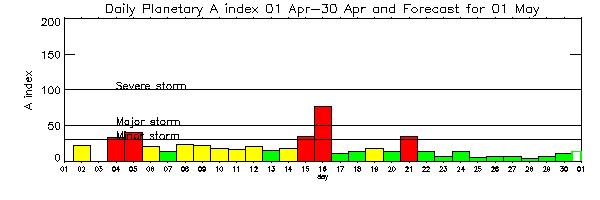
Geomagnetic activity can also be expressed using the ap and Ap indices, which provide a linear representation of geomagnetic disturbance. The ap index is a three-hour planetary index derived from the corresponding Kp value using a standardized conversion table. Unlike the quasi-logarithmic Kp scale, ap provides a linear measure of geomagnetic activity.
The eight ap values for a UTC day are averaged to obtain the Ap index. The following graph shows the near real-time planetary Ap index computed by the Australian Space Weather Forecasting Centre (ASWFC).
HF Radio & Space Weather is a resource dedicated to the operational monitoring of space weather and HF propagation conditions.
This is an educational, non-commercial website. All displayed data is property of their authors and credit and hyperlinks to the corresponding sources are provided. If you want to contact the webmaster, please use this form.