Solar Radiation Storms
Solar proton events, radiation-storm alerts and forecasts, and energetic-particle monitoring.
Introduction
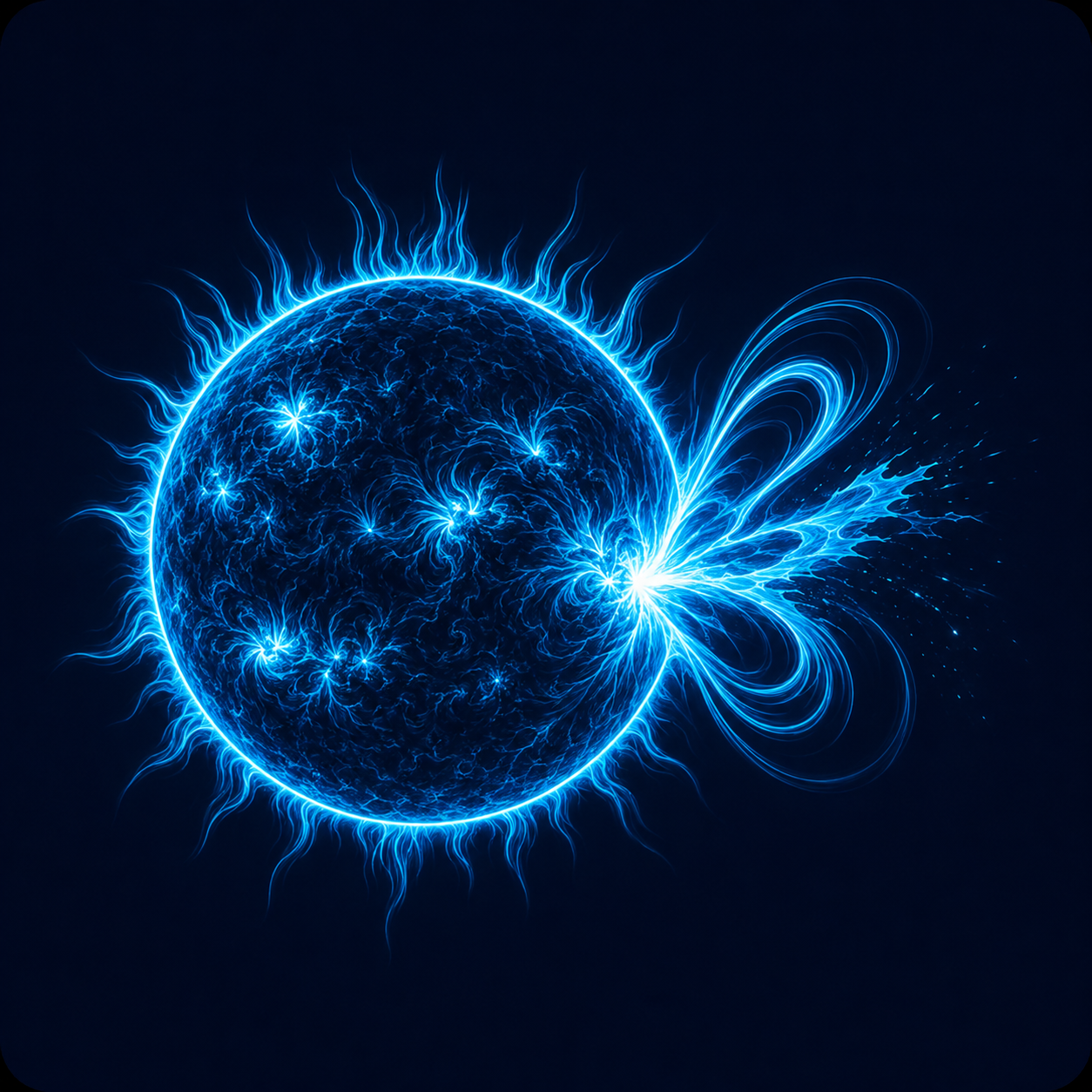
Solar Energetic Particle (SEP) events occur during major solar eruptions, when charged particles, primarily protons but also electrons and heavier ions, are accelerated to very high velocities, significantly exceeding those of the ambient solar wind. As a result, these particles acquire large amounts of kinetic energy and can travel rapidly through interplanetary space. Particle acceleration can occur in association with solar flares and with shock waves driven by fast coronal mass ejections (CMEs). When sufficiently high fluxes of energetic solar protons reach the near-Earth environment, they can produce solar radiation storms.
Solar radiation storms may begin within tens of minutes to several hours after a major solar eruption, depending on the energy of the particles, the acceleration process, and the magnetic connection between the eruption and Earth. Solar radiation storms can persist for hours or even days. These events can increase radiation exposure for astronauts and, particularly at high altitudes and high geomagnetic latitudes near the poles, for aircraft crew and passengers. They can also affect satellite operations, radio communications, and radionavigation systems.
During a solar radiation storm, energetic protons can penetrate into the polar atmosphere, increasing ionization in the lower ionosphere, particularly the D-region. This enhanced ionization increases the absorption of HF radio waves and can produce Polar Cap Absorption (PCA) events. The effects are strongest on propagation paths crossing high geomagnetic latitudes and may range from signal degradation to a complete loss of HF communications through the affected polar regions. The severity of the absorption depends on factors including the energetic-particle flux and spectrum, radio frequency, geomagnetic conditions, and solar illumination.
If a solar radiation storm occurs, please check the HF Absorption Levels in the Radio Communications section to monitor current HF absorption conditions.
Alerts and Forecasts (NOAA)



The National Oceanic and Atmospheric Administration (NOAA) developed its Space Weather Scales as a means of communicating current and expected space-weather conditions, together with their potential impacts on technological systems and human activities.
The "S scale" describes the intensity of solar radiation storms and ranges from S1 (Minor) to S5 (Extreme):
| Level | Expected HF impact |
|---|---|
| S1 Minor | Minor impacts on HF radio in the polar regions. |
| S2 Moderate | Small effects on HF propagation through the polar regions. |
| S3 Strong | Degraded HF radio propagation through the polar regions. |
| S4 Severe | Blackout of HF radio communications through the polar regions. |
| S5 Extreme | Complete blackout of HF radio communications possible through the polar regions. |
For a full description of the effects of solar radiation effects, please check NOAA Space Weather Scales.
Solar Energetic Particle (SEP) Monitors
The intensity of solar radiation storms is quantified from the flux of energetic solar protons with energies ≥10 MeV measured in the near-Earth environment. These protons are associated with Solar Energetic Particle (SEP) events produced by major solar eruptions.
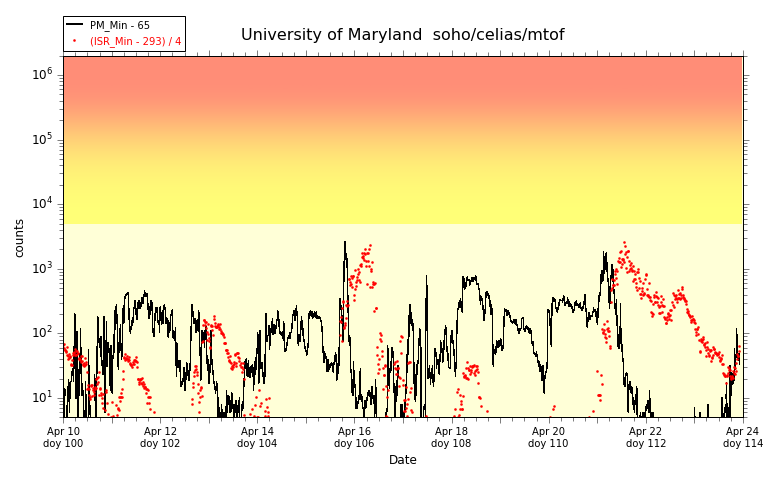
This monitor provides an indirect indication of energetic-particle activity using the PM_Min parameter derived from background counting rates in the SOHO CELIAS/MTOF Proton Monitor. During solar energetic particle events, energetic particles generate secondary particles within the instrument, increasing the counting rate across its measurement channels.
Very high solar-wind density or temperature can also produce elevated PM_Min values, so the parameter should not be interpreted as a direct measurement of solar proton flux. According to the instrument team, values above approximately 6000 generally indicate the presence of energetic particles associated with major solar events, although energetic-particle enhancements may be detectable at much lower values under quiet solar-wind conditions.
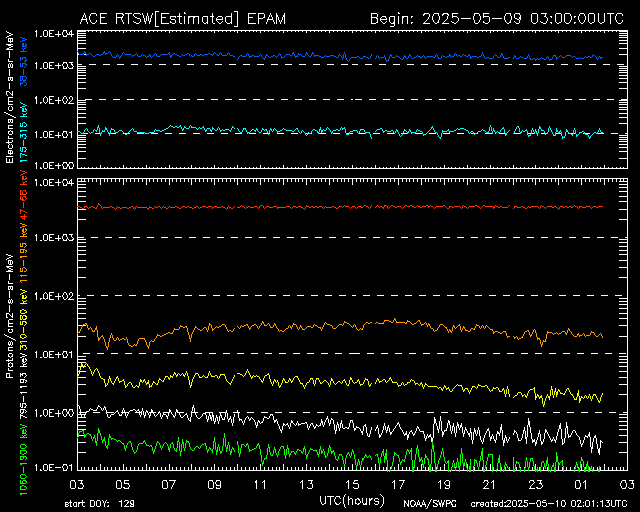
The plots show energetic electron and proton fluxes measured by ACE/EPAM in several energy channels. The displayed proton channels cover energies from approximately 47 keV to 1.9 MeV, while the electron channels cover energies from approximately 38 to 315 keV. Enhancements in these channels can indicate the arrival of energetic particles associated with solar energetic particle events and interplanetary shocks.
ACE EPAM stands for Advanced Composition Explorer Electron, Proton, and Alpha Monitor. The instrument measures energetic ions and electrons over a broad range of energies and provides near-real-time measurements of the energetic-particle environment upstream of Earth.
HF Radio & Space Weather is a resource dedicated to the operational monitoring of space weather and HF propagation conditions.
This is an educational, non-commercial website. All displayed data is property of their authors and credit and hyperlinks to the corresponding sources are provided. If you want to contact the webmaster, please use this form.